


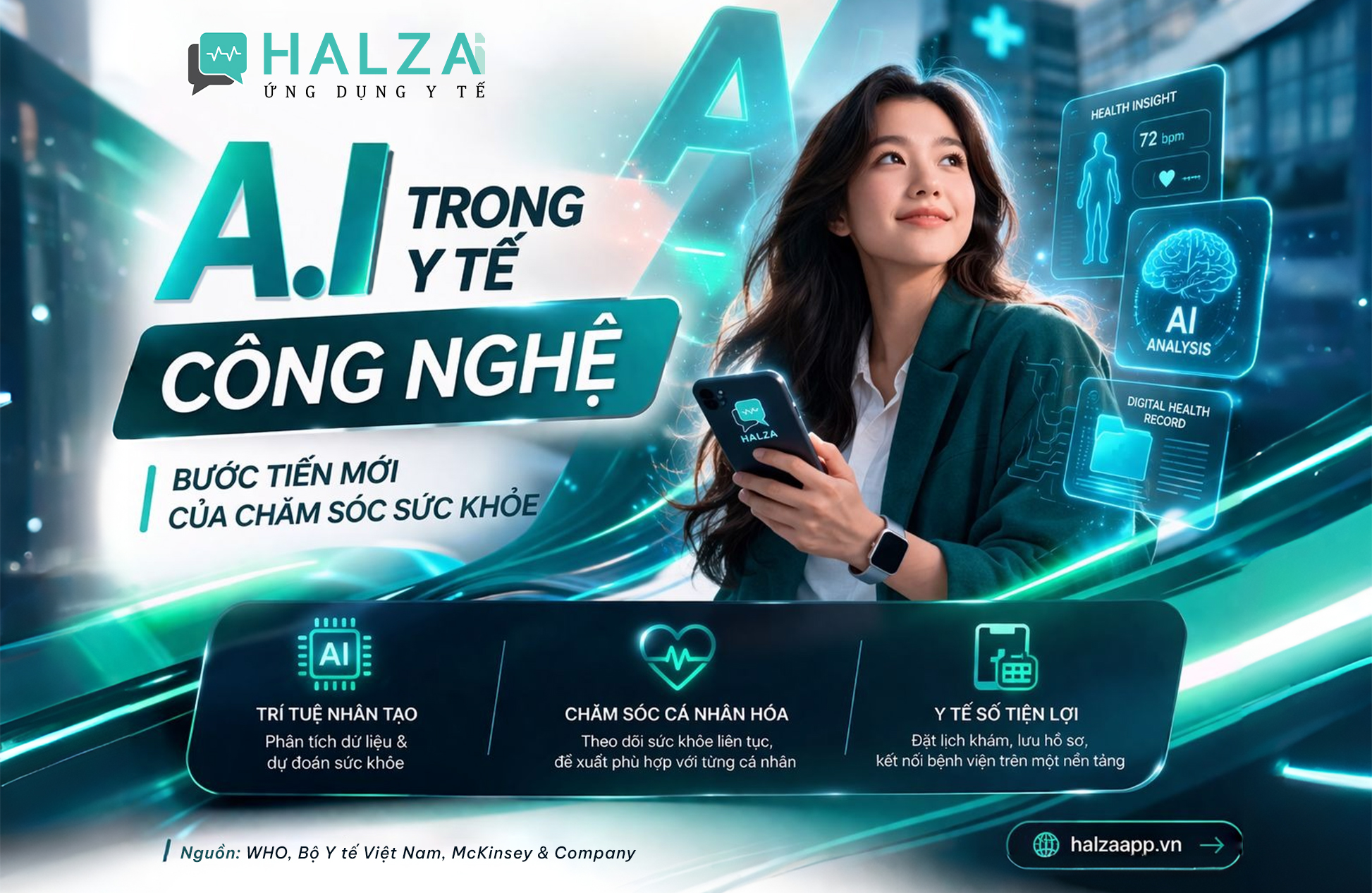

When healthcare is no longer “reactive” – but “predictive”
1.A.I – what is it doing in modern healthcare?
For many years, healthcare has worked like this:
- Fall ill → see a doctor → get treatment
But with the development of artificial intelligence (AI), this model is changing:
From “treating disease” → to “predicting & preventing disease”
According to the World Health Organization:
AI has the potential to help:
- Detect disease earlier
- Personalise treatment
- Reduce the burden on the health system
2.Real-world applications of A.I in healthcare today
a.More accurate diagnostic imaging
-AI can read:
- X-rays
- MRI
- CT scans
-> With high accuracy, helping doctors detect cancer and stroke early
According to Stanford University:
AI can match the accuracy of doctors in certain imaging diagnoses.
b.Analysing medical record data (EMR)
-AI can:
- Read medical records
- Find patterns of disease
- Suggest treatment options
-> This is the very foundation of personalised medicine (personalized medicine)
c.Intelligent medical assistants
- Chatbots that support patients
- Medication reminders
- Tracking of health measurements
-> Helping patients take more initiative rather than depending entirely on hospitals
3.How is healthcare in Vietnam changing?
-Vietnam is entering a period of rapid digital transformation in healthcare:
-According to the Ministry of Health of Vietnam:
- Accelerating electronic medical records (EMR)
- Connecting data between hospitals
- Applying AI & telemedicine
The goal:
Building a digital health ecosystem – interoperable – personalised
4.The biggest challenge: data & user experience
-Although the technology is ready, in practice:
- Health data is still FRAGMENTED
- Users find information hard to access
- The experience is inconsistent
-> And this is precisely the “gap” in the market
5.Halza – the bridge between technology and the personal healthcare experience
-In that picture, Halza is not a hospital
-> It is the technology layer connecting the entire healthcare ecosystem
What does Halza offer?
- 📂 Storage of electronic medical records (EMR) for individuals
- 🤖 AI support for reading & understanding medical records
- 📅 Fast appointment booking at many hospitals
- 🛒 Access to genuine medical products
6. The core difference
- Halza does not replace doctors
-> Halza helps you understand your own body before you see a doctor
7.The future of healthcare: complete personalisation
-According to McKinsey & Company:
-AI will be the core factor moving health systems towards a personalised model over the next 5–10 years
-> Each person will have:
- Their own health record
- Their own treatment protocol
- Their own care journey
💬 A question for you
If technology could let you know your health risks in advance
-> would you want to use it?
8. Conclusion
AI does not replace people
-> But it will change the way we look after ourselves
And in the near future:
Those who understand their own health data
-> will be the ones who live healthier lives
Visit: www.halzaapp.vn to:
- 📅 Book appointments free of charge
- 🏥 Compare trusted hospitals
Download the App to:
- 📁 Store electronic medical records
- 🤖 AI reminders for routine screening
 Back to all articles


