


“Children's eyes are not designed to look at screens for hours every day.”
— American Academy of Ophthalmology
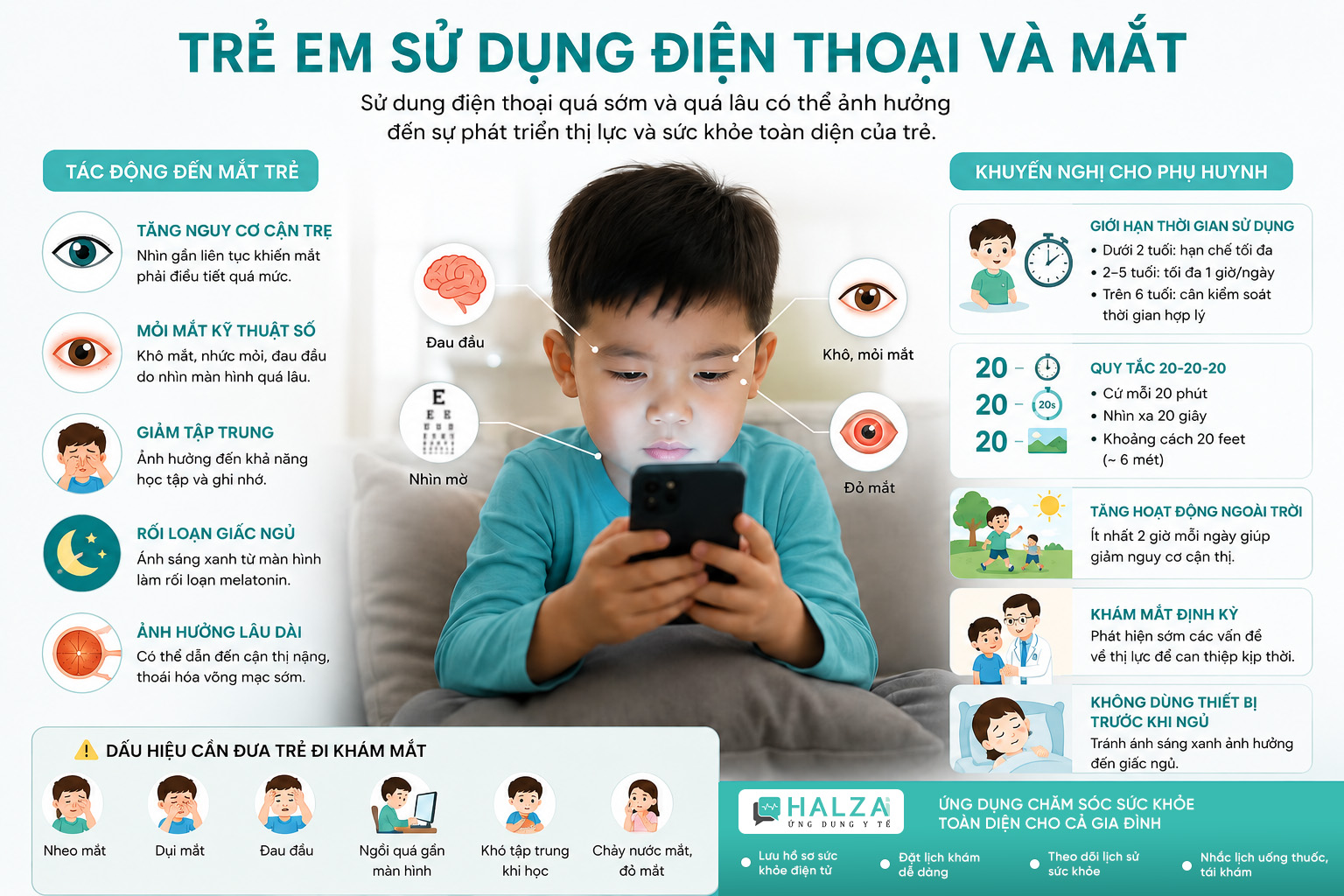
⚠️Signs Parents Should Not Ignore
If your child regularly shows the following signs, take them for an eye test:
- Squinting when looking into the distance
- Rubbing their eyes constantly
- Complaining of headaches
- Sitting too close to the TV or a screen
- Watery or red eyes
- Difficulty concentrating when studying
- Going to sleep late after using a phone
“School Short-sightedness” Is Affecting Ever Younger Children
- In the past, short-sightedness usually appeared in the teenage years.
Today, many children aged 5–7 already need glasses.
Experts point to several causes:
📱 Using phones/tablets too early
🏠 Too little outdoor activity
📚 Constant close-up study
💡 Unsuitable ambient lighting
- According to the World Health Organization (WHO), children under 5 should have their screen time strictly limited in order to protect their physical and mental health.
- In many modern families, the smartphone has become a reluctant “babysitter”.
An iPad to keep a child sitting still at mealtimes. A YouTube video to stop the crying. A phone so that “the child can learn English”.
But behind that convenience, eye doctors around the world are recording a worrying picture:
⚠️ Children are becoming short-sighted earlier.
⚠️ Dry eye is appearing even in primary school children.
⚠️ Sleep disturbance and reduced concentration are increasingly common.
And the phone screen is one of the biggest causes.
⸻
👁️Why Are Children's Eyes More Vulnerable Than Adults'?
A child's eyes are still developing.
When they look at a screen close up for long stretches of time, the eyes have to over-accommodate.
This can lead to:
- A higher risk of early short-sightedness
- Tired eyes from screen use (Digital Eye Strain)
- Dry eye caused by blinking less often
- Headaches and aching eyes
- Reduced ability to concentrate on schoolwork
- According to the American Academy of Ophthalmology, excessive screen use in children is linked to the rising rate of short-sightedness worldwide.
- A study published in JAMA Ophthalmology also found that higher screen time is associated with the risk of myopia progression in young children.
⏳How Much Screen Time Is “Safe”?
According to the recommendations of the American Academy of Pediatrics:
* Under 2 years: keep screen use to an absolute minimum
* 2–5 years: no more than about 1 hour/day of quality content
* Older children: keep the time sensible and build in breaks for the eyes
Experts also encourage the 20-20-20 rule:
👉 For every 20 minutes of screen time
👉 Give the eyes a 20-second break
👉 And look about 20 feet (~6 metres) into the distance
💙What Matters Is Not “Banning” But “Balance”
In a technological age, children's contact with electronic devices is almost impossible to avoid.
What matters is:
* Controlling how long they use them
* Increasing outdoor activity
* Regular eye examinations
* Watching for unusual signs early
Because many eyesight problems, if found late, can affect a child's learning and long-term development.
⸻
📲Halza Alongside Families In Tracking Children's Health
With the Halza App, parents can:
📁 Store eye examination records & digital glasses prescriptions
🩺 Book appointments quickly with healthcare facilities
📲 Follow their child's health history in a single app
🤖 Manage medical information more conveniently for the whole family
⸻
Medical references:
* American Academy of Ophthalmology (AAO)
* American Academy of Pediatrics (AAP)
* World Health Organization (WHO)
* JAMA Ophthalmology
 Back to all articles


